

How To Avoid Trick Or Treaters
Ah, Halloween.
Tonight's the one nighttime of the twelvemonth when children can don their favorite costumes, temporarily transforming themselves into lilliputian Olafs and Annas and Elsas, and giddily skip around their local neighborhoods, knocking on doors, cheerfully thrusting their buckets out towards those who answer, grinning their wide, toothy smiles, and screaming, "Play a joke on OR Care for!"
If they're really lucky -- ohhhh, if they really hit the trick-or-treaters' jackpot -- they'll stumble upon the Holy Grail of trick-or-treating quests. They'll find a house -- maybe even a few -- where the owners simply left a bowl of processed out for the taking, probable with a sign requesting, ever-then-sweetly, "Please Take Simply Ane!"
Ha. Equally if that'll happen.
All the same, even those of us who aredomicile tonight to paw out candy to the neighborhood kiddos know that the "Delight take only one!" request doesn't...always get respected. All yous have to do is plough your back or show a sign of weakness, and BAM. It can exist a gratis-for-all effectually that candy bowl.
This play tricks-or-treating dilemma is such a familiar feel for so many people that in 1976, a squad of psychologists in Seattle led by Ed Diener thought of this annual experience and decided to utilise it to comport a little experiment ondeindividuation.
Deindividuation, briefly, is a psychological theory stating that when nosotros are in groups, we lose some of our self-awareness and become more probable to human action in disinhibited, not-socially-normative ways. Information technology'southward a piffling more complicated than "peer force per unit area" or "going with the catamenia." Information technology's more about the fact that (a) when we're surrounded by people, it makes us feel more physically amped up, and (b) when nosotros experience bearding, we feel less self-conscious and less responsible for our deportment. The combo of college physiological arousal and lower self-awareness means that in these situations, we're more likely to lose our inhibitions and do some brazen things that we otherwise might non.
Going back to our story to a higher place, you can think of "taking more candy than y'all're supposed to take" as a Halloween-specific example of disinhibited, socially-inappropriate, transgressive behavior -- you're breaking the rules that you've been given, and you're doing something that you're not supposed to be doing. Diener and his colleagues wanted to run across if they could play around with some of the different situational factors that are thought to influence the strength of deindividuation's effects, and see whether or not these factors actually had any influence on how many kids would steal some actress sweets if they got the opportunity.

If deindividuation gets enhanced when people feel less cocky-aware and more physiologically aroused, anything that (a) increases anonymity and/or (b) puts them in agrouping will exercise the trick -- and, conversely, anything that makes people feel more identifiable, individuated, or distinct will dampen it. The presence (or absence) of groups was out of the researchers' control -- kids either showed up alone or in groups of friends. But what the researcherscould do was play around with that other factor -- anonymity -- and come across how information technology impacted the trick-or-treaters differently based on whether or not they were there with friends.
When the kids showed upwardly at the doors of the 27 Seattle homes included in this study, there was always an experimenter in that location to open the door -- an experimenter who didn't live in the neighborhood, and thus was unfamiliar to the kids. For half of the i,000+ trick-or-treaters that unknowingly participated in this study on that Halloween dark in the late 1970s, the experimenter simply greeted them warmly, told them that they could each accept exactlyane candy from the bowl sitting in front end of them in the hallway, so said that she had to go back to some other room in the business firm to finish up some work. For the other half, the experimenter did the same thing -- except that before she offered them the candy and fabricated her get out to the back of the house, she explicitly asked all of the trick-or-treaterswhat their names were andwhere they lived. After repeating the information back to them -- making it clear that she knew exactly who they were and where they lived -- she told them about the "Ane Processed Simply" rule and made her exit. Unbeknownst to the kids, though, her "piece of work" really just took her back behind a little hidden peephole -- where she could come acrossexactly what those lil' costumed mischief-makers were doing.
What practice you lot recall happened?

As the researchers had expected, the two factors ofanonymity andgroup presence made a huge difference in how skillful -- or bad -- the trick-or-treaters ended up existence. Only7.v% of the pull a fast one on-or-treaters who showed up to the houses alone and provided their names and addresses ended up stealing extra candy out of the basin. On the opposite end of the spectrum, however, were the naughty little flim-flam-or-treaters who showed up in groups and stayed anonymous. A whopping57% of those trick-or-treaters ended up sneaking a few actress candies from the bowl when they thought nobody was looking.
"Only look," an astute reader might note right almost at present. "Are we sure this is specifically about deindividuation? Maybe it's really just about peer pressure level?"
Well, information technology is. A little. But likewise non.

As yous tin run across higher up, the trick-or-treaters' behavior was shaped by what the first kid in the group ended up doing. If the "leader of the pack" who got commencement dibs at the candy bowl decided to palm a few actress sweets, the majority of her comrades ended up deciding to practice the aforementioned. On the other hand, though, if the first kid decided to exist skillful and only take one candy, a whopping 90% of the rest of the group followed suit. And so, at that place'due south definitely show formodeling here -- the kids didwatch what the first trick-or-treater did, and used his beliefs as a guide. If he stole, they stole. If she didn't, they didn't.
But...


...that can't possibly be the entire story, because that beginning kid to go upwardly nevertheless had to brand a decision most what to do, and that conclusion was fabricated in the absence of data about other grouping members (since, well, he was the get-go child to become a crack at the candy bowl). As you tin can see in the graphs in a higher place, when the researchers went dorsum and looked specifically at what theoffset child in a grouping decided to do, they found that significantly more of those trick-or-treaters than expected (based on the solo-kid rates) stole extra candies --especially when they had the added bonus of being anonymous.
This clues us into the fact that thereis something special about merely being in a group, even if you aren't strictly modeling your own behavior after the other group members -- and there issomething special about being bearding, peculiarly when yous're amped up from having a bunch of your buddies around you.
The moral of the story here? If yous want your play a joke on-or-treaters to obey the i-candy-merely dominion -- well, keeping a shut middle on your processed bowl is probably your best bet. But you can besides innocently inquire your trick-or-treaterswhat their names are andwhere they live.
Research suggests that if yous simply enquire these two simple questions, you volition reap great rewards -- in the form of a gloriously non-depleted candy bowl come up November 1st.
Reference
Diener, Eastward., Fraser, S.C., Beaman, A.L., & Kelem, R.T. (1976). Effects of deindividuation variables on stealing among Halloween play tricks-or-treaters.Journal of Personality and Social Psychology, 33, 178-183.
Image Credits
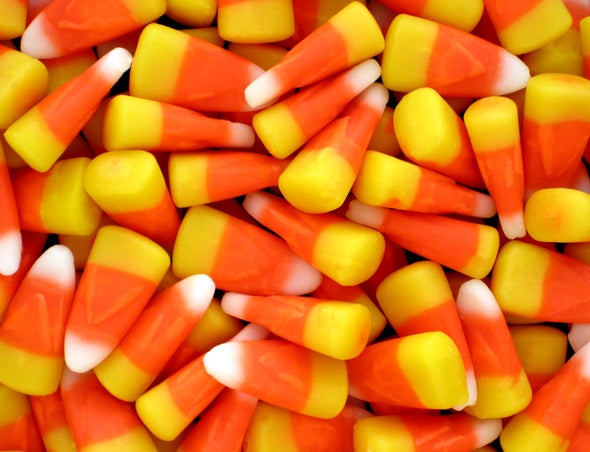
Processed Corn by Evan Amos via Wikimedia Commons
Trick or Treaters past Belinda Hankins Miller via Wikimedia Commons
The views expressed are those of the writer(southward) and are not necessarily those of Scientific American.
ABOUT THE Writer(Due south)

Source: https://blogs.scientificamerican.com/psysociety/dont-let-greedy-trick-or-treaters-hijack-your-halloween-stash/
0 Response to "How To Avoid Trick Or Treaters"
Post a Comment