

For The Additional Green Spaces To Be Considered Public Services, What Must Be True?
Three Special Stakeholders: Society, the Surroundings, and Government
Sustainability: Business and the Environs
Learning Objectives
Past the end of this section, you will be able to:
- Explain the concept of earth jurisprudence
- Evaluate the claim that sustainability benefits both business and the environment
- Place and depict initiatives that effort to regulate pollution or encourage businesses to prefer clean free energy sources
Public concern for the natural environs is a relatively new phenomenon, dating from the 1960s and Rachel Carson's seminal book Silent Leap, published in 1962. In 1992, Cormac Cullinan's Wild Law proposed "earth justice" or "globe jurisprudence," a concept underlying the law'due south ability to protect the environment and effectively regulate businesses that pollute. The preoccupation with concern success through investment in corporations, in contrast, is a much older concept, dating back at least to the creation of the British Eastward India Visitor in 1600, and the widespread emergence of the corporation in Europe in the 1700s. If you were a business possessor, would yous be willing to spend company resources on ecology issues, fifty-fifty if not required to practise and so by police? If and so, would you be able to justify your actions to shareholders and investment analysts as smart business decisions?
Environmental Justice
If a business action harms the surroundings, what rights does the environment have to fight back? Corporations, although a form of business entity, are actually considered persons in the optics of the police. Formally, corporate personhood, a concept we touched on in the preceding section, is the legal doctrine holding that a corporation, divide and apart from the people who are its owners and managers, has some of the aforementioned legal rights and responsibilities enjoyed by natural persons (physical humans), based on an interpretation of the word "person" in the Fourteenth Amendment.
The generally accepted constitutional footing for allowing corporations to assert that they take rights similar to those of a natural person is that they are organizations of people who should not exist deprived of their rights simply because they act collectively. Thus, treating corporations as persons who take legal rights allows them to enter into contracts with other parties and to sue and be sued in a court of law, forth with numerous other legal rights. Before and afterwards the Supreme Court'southward ruling in Citizens United five. Federal Ballot Committee (2010), which upheld the Start Amendment free-voice communication rights of corporations, there have been numerous challenges to the concept of corporate personhood; nonetheless, none have been successful. Thus, U.S. police force considers corporations to be persons with rights protected nether fundamental constitutional amendments, regulations, and case law, also as responsibilities under the law, just every bit human persons accept.
A question that logically springs from judicial interpretations of corporate personhood is whether the environs should relish like legal condition. Should the environment exist considered the legal equivalent of a person, able to sue a concern that pollutes information technology? Should environmental advocates have been able to file a lawsuit against BP (formerly British Petroleum) on behalf of the entire Gulf of Mexico for harm created past the 2010 Deepwater Horizon oil spill (discussed in more item in the government regulation section of this chapter), which, at 5 million barrels, was x times larger than the famous Exxon Valdez spill and remains the largest and most widespread body of water oil spill in the history of the global petroleum industry? Furthermore, the Deepwater Horizon spill afflicted not only thousands of businesses and people, merely likewise the entirety of the Gulf of Mexico, which will suffer impairment for years to come. Should the Gulf of Mexico have legal standing to sue, just similar a person?
While U.S. jurisprudence has not yet officially recognized the concept that Globe has legal rights, there are examples of progress. Ecuador is now the get-go country to officially recognize the concept.
The country rewrote its Constitution in 2008, and it includes a section entitled "Rights for Nature." It recognizes nature's correct to exist, and people have the legal authority to enforce these rights on behalf of the ecosystem, which tin itself exist named as a litigant in a lawsuit.
Globe jurisprudence is an interpretation of law and governance based on the belief that society will be sustainable but if nosotros recognize the legal rights of Earth as if it were a person. Advocates of globe jurisprudence assert that there is legal precedent for this position. As pointed out earlier in this chapter, information technology is not only natural persons who accept legal rights, but also corporations, which are artificial entities. Our legal system besides recognizes the rights of animals and has for several decades. Co-ordinate to earth jurisprudence advocates, officially recognizing the legal status of the surround is necessary to preserving a healthy planet for future generations, in particular because of the problem of "invisible pollution."
Businesses that pollute the surroundings often hide what they are doing in order to avert getting caught and facing economic, legal, or social consequences. The only witness may exist World itself, which experiences the harmful impact of their invisible actions. For example, every bit revealed in a recent report,
companies all over the world take for years been secretly burning toxic materials, such as carbon dioxide, at night. A company that needs to dump a toxic substance usually has three choices: dispose of it properly at a condom facility, recycle and reuse information technology, or secretly dump it. There is no doubt that dumping is the easiest and cheapest choice for most businesses.
Every bit another example, approximately twenty-five million people board prowl ships every year, and equally a result, cruise ships dump one billion gallons (3.8 billion liters) of sewage into the oceans annually, usually at night so no one sees or smells information technology. Friends of the Globe, a nongovernmental arrangement (NGO) concerned with ecology issues, used information from the U.Southward. Environmental Protection Agency (EPA) to calculate this effigy.
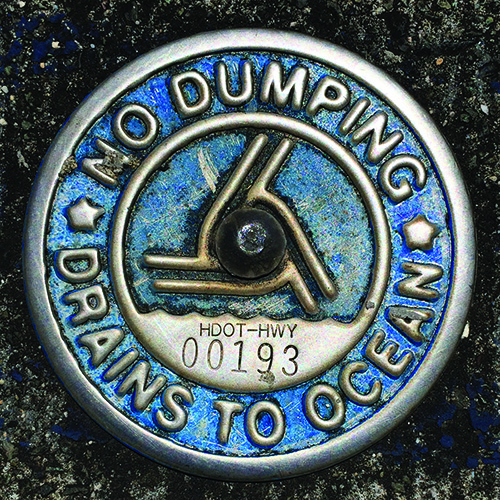
The sewage dumped into the sea is full of toxins, including heavy metals, pathogens, bacteria, viruses, and pharmaceutical drugs ((Figure)). When invisibly released about coasts, this untreated sewage tin kill marine animals, contaminate seafood, and sicken swimmers, and no 1 registers the harm except the ocean itself. Many believe the environment should have the right not to be secretly polluted in the expressionless of night, and Earth should have rights at least equal to those of corporations.
A warning in Honolulu regarding the damage done past sea dumping. (credit: "No Dumping – Drains to Ocean" by Daniel Ramirez/Wikimedia Commons, CC BY 2.0)
Cormac Cullinan, an environmental attorney, author, and leading proponent of globe jurisprudence, often collaborates with other environmental advocates such as Thomas Berry, an eco-theologian, scholar, and author. Cullinan, Berry, and others have written extensively virtually the important legal tenets of earth jurisprudence; however, it is not a legal doctrine officially adopted by the The states or any of its states to date. The concept of earth justice is tied indirectly to the economical theory of the "tragedy of the eatables," a phrase derived from British economist William Forster Lloyd, who, in the mid-nineteenth century, used a hypothetical example of unregulated grazing on common country to explain the human tendency to deed independently, putting self-interest first, without regard for the common practiced of all users. The theory was later popularized by ecologist and philosopher Garrett Hardin, who tied it directly to ecology issues. In other words, when it comes to natural resources, the tragedy of the commons holds that people generally use equally much of a gratis resource as they desire, without regard for the needs of others or for the long-term environmental furnishings. As a way of combating the tragedy of the commons, Cullinan and others have written about the concept of earth justice,
which includes the post-obit tenets:
"The Earth and all living things that constitute it have fundamental rights, including the right to be, to take a habitat or a place to be.
Humans must adjust their legal, political, economic, and social systems to be consistent with the key laws or principles that govern how the universe functions.
Human acts, including acts by businesses that infringe on the fundamental rights of other living things violate fundamental principles and are therefore illegitimate and unlawful."
The concept of world justice relies heavily on Garrett Hardin's word of the tragedy of the commons in Science in 1968.
This classic analysis of the environmental dilemma describes how, from colonial times, Americans regarded the natural environment as something to be used for their own farming and business ends. Overuse, still, results in the inevitable depletion of resources that negatively affects the surround, then that information technology eventually loses all value.
Today, supporters of the surroundings affirm that regime has both a right and an obligation to ensure that businesses do not overuse whatsoever resource, and to mandate adequate environmental protection when doing so. In addition, some form of fee may be nerveless for using up a natural resource, such as severance taxes imposed on the removal of nonrenewable resources like oil and gas, or deposits required for possible cleanup costs after projects have been abandoned. As part of the growing acceptance of the concept of earth justice, several nonprofit educational organizations and NGOs accept go active in both lobbying and ecology litigation. One such organization is the Center for Earth Jurisprudence (housed at the Barry Schoolhouse of Constabulary in Orlando), a nonprofit group that conducts research in this area.
The following video describing the Middle for Earth Jurisprudence discusses back up for laws that legally protect the sustainability of life and health on Earth, focusing upon the springs and other waters of Florida.
Why Sustainability Is Expert for Business concern
The notion that the environment should exist treated as a person is relatively new. But given the prominence of the ecology move worldwide, no well-managed business organization today should be conducted without an awareness of the tenuous balance between the health of the environs and corporate profits. It is quite simply good business organisation exercise for executives to be aware that their enterprise's long-term sustainability, and indeed its profitability, depend greatly on their safeguarding the natural environment. Ignoring this interrelationship between business and the environment non only elicits public condemnation and the attention of lawmakers who listen to their constituents, but it also risks destroying the viability of the companies themselves. Virtually all businesses depend on natural resource in one mode or another.
Progressive corporate managers recognize the multifaceted nature of sustainability—a long-term approach to business activity, environmental responsibility, and societal impact. Sustainability affects not only the environment but also other stakeholders, including employees, the community, politics, law, scientific discipline, and philosophy. A successful sustainability program thus requires the commitment of every office of the company. For example, engineers are designing manufacturing and production processes to run across the demands of companies dedicated to sustainability, and the idea of visitor-wide sustainability is now mainstream. Many of the largest companies in the world see sustainability every bit an important part of their future survivability.
The Global 100 and Sustainability'southward Strategic Worth
Corporate Knights is a Canadian inquiry and publishing company that compiles an almanac list called the Global 100, identifying the earth's most sustainable companies.
The 2018 edition of the list, presented at the Globe Economical Forum in Davos, Switzerland, shows that an increasing number of major multinational companies have sustainability seriously, including many U.South. businesses. The highest-ranking U.South. company is technology giant Cisco, which ranks seventh on the Global 100 listing.
Other U.S. companies in the top 20-5 include Autodesk, Merck, and McCormick & Co. The countries with the best representation on the list are primarily from North America and Western Europe: the U.s.a. (18), France (15), the U.k. (10), Germany (7), Brazil (5), Finland (v), and Sweden (5).
Yous may await that companies dedicated to sustainability would be less profitable in the long run as they face additional costs. In fact, information from the Global 100'south return on investment shows this is not the instance. Allow's examine the prove. If an investor had put $250 in Global 100 companies in 2005, information technology would have been worth $580 in 2015, compared to $520 for the same corporeality invested in a typical index fund. The Global 100'due south cumulative render on high-sustainability firms is about 25 percentage higher than a traditional investment.
Cisco Systems, number seven on the global list, is a good example of how greenish procurement and sustainable sourcing have become a regular part of the supply chain. At Cisco, according to a top-level supply chain executive, "we take seriously the responsibility of delivering products in an upstanding and environmentally responsible manner."
Cisco relies on its Supplier Code of Conduct to set standards for suppliers and so they follow fair labor practices, ensure safe working conditions, and reduce their carbon footprint, the amount of carbon dioxide and other carbon compounds released by the consumption of fossil fuels, which tin exist measured quantitatively (see the link below). Cisco is in the process of embedding sustainability into supply chain direction at all levels.
Do you know what your carbon footprint is? This personal footprint computer allows you to observe out where you stand.
Another company dedicated to sustainability is Siemens, which was ranked number ix on the 2018 list. Siemens is a multinational industrial conglomerate headquartered in Germany, whose businesses range from power plants to electrical systems and equipment in the medical field and high-tech electronics. Siemens was rated the nigh energy-efficient house in its sector, considering it produced more than dollars in acquirement per kilowatt used than any other industrial corporation. This is a standard technique to judge efficiency and demonstrates that Siemens has a low carbon footprint for a company in the industries in which it operates. The commitment of Siemens to sustainability is further demonstrated by its determination to manufacture and sell more environmentally friendly infrastructure products such every bit dark-green heating and air-conditioning systems.
Cisco and Siemens evidence that businesses across the globe are starting to empathize that for a supply concatenation to be sustainable, companies and their vendors must be partners in a clean and prophylactic environment. Practise businesses merely pay lip service to ecology bug while using all available natural resources to make equally much coin as they can in the present, or are they really committed to sustainability? There is abundant show that sustainability has become a policy adopted by businesses for financial reasons, not simply public relations.
McKinsey & Company is one of the globe'south largest management consulting firms and a leader in the use of data analytics, both qualitative and quantitative, to evaluate management decisions. McKinsey conducts periodic surveys of companies around the world on matters of importance to corporate leaders. In the 2010 survey, 76 pct of executives agreed that sustainability provides shareholders long-term value, and in the 2014 survey, entitled "Sustainability'southward Strategic Worth," the data indicated that many companies consider cost savings to be the number-1 reason for adopting such policies. Toll cutting, improved operations, and efficiency were indicated as the main reasons for adopting sustainability policies past over ane-tertiary of all companies (36%).
Other major studies accept demonstrated similar results. Grant Thornton is a leading global accounting and consulting house. Its 2014 study on CSR showed that the top reason companies cite for moving towards more than environmentally responsible business practices is financial savings. Grant Thornton conducted more 2,500 interviews with clients and business executives in approximately 30-five countries to discover why companies are making a delivery to sustainable practices. The study establish that cost management was the key reason for sustainability (67%).
A specific example is Dell Computers, headquartered outside Austin, Texas, and with operations all over the world. The "Dell Legacy of Good Programme" has set a goal to reduce greenhouse gas emissions from all facilities and operations past l percent by the year 2020, along with several other environmental goals. As part of this overall plan, Dell created the Continued Workplace, a flex-work program allowing alternative arrangements such as variable work hours to avoid rush 60 minutes, full- or role-time work at habitation flexibility, and job sharing. This sustainability initiative helps the visitor avert about seven thousand metric tons of greenhouse gas emissions, and, directly related to the fiscal benefit of sustainability, it saves the company approximately $12 million per year.
However, adopting sustainability policies may require a long-term outlook. A recent commodity in the Harvard Business Review discussed the issue of sustainability and how information technology tin create real cost savings ((Figure)). "It'due south hard for companies to recognize that sustainable production can exist less expensive. That's in part because they have to fundamentally modify the manner they remember about lowering costs, taking a leap of faith . . . that initial investments made in more-plush materials and methods will lead to greater savings down the road. It may besides require a willingness to buck conventional financial wisdom past focusing non on reducing the cost of each part but on increasing the efficiency of the system every bit a whole."
Sustainability can create long-term toll savings for companies. (credit: work by Nattanan Kanchanaprat/Pixabay, CC0)

Sustainability Standards
The International Organization for Standardization, or ISO, is an independent NGO and the world's largest developer of voluntary international business organisation standards. More than twenty thousand ISO standards now cover matters such every bit sustainability, manufactured products, technology, food, agriculture, and even healthcare. The adoption and use of these standards by companies is voluntary, merely they are widely accustomed, and following ISO certification guidelines results in the creation of products and services that are clean, safe, reliable, and fabricated by workers who enjoy some caste of protection from workplace hazards.
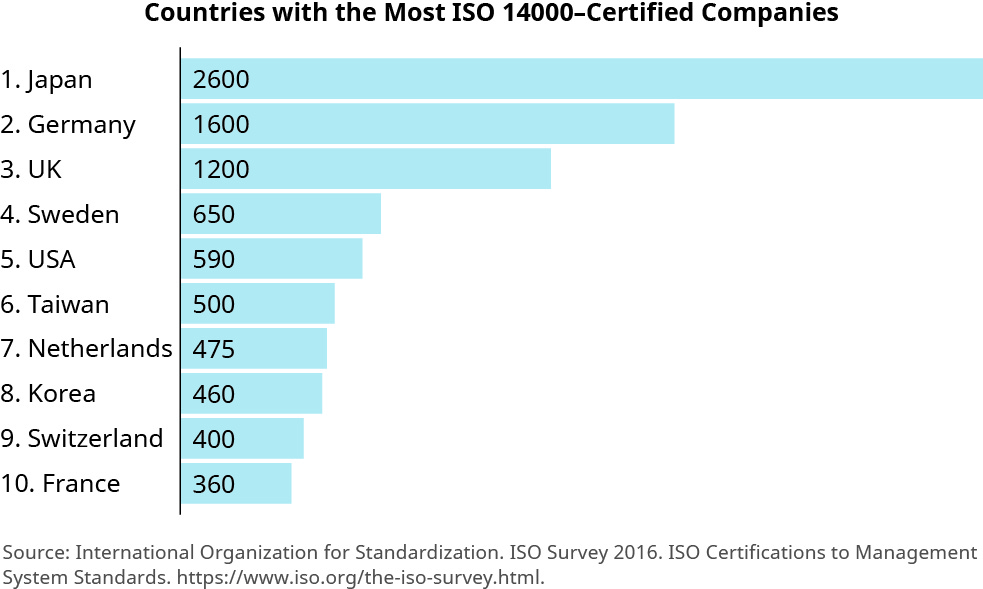
In the environmental area, the ISO 14000 serial of standards promotes effective environmental management systems in business organizations past providing price-constructive tools that make use of best practices for environmental management. These standards were developed in the 1990s and updated in 2015; they cover everything from the eco-design (ISO 14006) of factories and buildings to environmental labels (ISO 14020) to limits on the release of greenhouse gasses (ISO 14064). While their adoption is nonetheless voluntary, a growing number of countries allow only ISO 14000-certified companies to bid on public government contracts, and the same is true of some individual-sector companies ((Effigy)).
According to recent reports, close to 15 thousand companies worldwide take chosen to be ISO 14000 certified, including Nissan, Ford, and IBM. (attribution: Copyright Rice University, OpenStax, under CC BY four.0 license)
Some other type of sustainability standard with which businesses may elect to comply is LEED certification. LEED stands for Leadership in Energy and Environmental Design, and it is a rating system devised by the U.South. Light-green Building Council to evaluate a construction's environmental performance. The nearly famous example is the Empire State Building in New York City, which was awarded LEED Gold status (for existing buildings). The LEED certification was the consequence of a multimillion-dollar rebuilding plan to bring the building upwardly to appointment, and the building is the tallest in the U.s. to receive it. There are dozens of other examples of big commercial buildings, such as the Wells Fargo Belfry in Los Angeles, as well as thousands of smaller buildings and residential homes. LEED certification is the driver backside the ongoing market transformation towards sustainable pattern in all types of structures, including buildings, houses, and factories.
The Loftier Cost of Inaction
According to estimates from the EPA, by the year 2050, World'due south population will exist near x billion people. Dramatic population growth has had a very significant and ofttimes negative human impact on the planet. Not only are there more people to feed, business firm, and care for, just new technologies let businesses to harness natural resources in unprecedented amounts. NGOs and authorities agencies alike have taken detect. For years, the Department of State and the Department of Defense have considered climate modify to be a potential threat to the long-term security of the United States. If unmanaged, climatic change could pose a risk to both U.S. security and Department of Defense facilities and operations.
Other respected organizations are also alerting the public to the risks of ignoring climate change.
The Union of Concerned Scientists (UCS) has released a detailed report identifying approximately twenty serious risks that volition be faced if the problem is not addressed in a substantial way. These risks include rise seas and increased coastal flooding, more than intense and frequent oestrus waves, more than destructive hurricanes, wildfires that concluding longer and produce more damage, and heavier atmospheric precipitation in some areas and more than astringent droughts in other areas. In addition to extreme atmospheric condition events, there would likely be widespread forest expiry in the Rocky Mountains and other mount ranges, the destruction of coral reefs, and shifts in the ranges of plants and animals. Both armed services bases and national landmarks would exist at risk, as would the electrical grid and nutrient supply. The UCS, with a membership consisting of the globe'due south most respected scientists, bases its projections on scientific inquiry studies that take produced empirical evidence of climate change. Its official position is that "global warming is already having significant and very costly furnishings on communities, public health, and our surroundings."
Environmental protection and climatic change problems receive varying degrees of support at the national level, depending on the commitment different presidents make to them. During periods in which the administration in Washington demonstrates a lower priority for climate alter issues, such as the Trump administration's appear intention to withdraw from the Paris Climate Accord, private companies may accept the lead on actions to reduce global warming emissions.
For case, Microsoft founder Bill Gates recently announced the creation of a private initiative to invest $20 billion on climate-related inquiry and development over the next five years. This is an example of regime-funded early experimental research that a business organization may be able to turn into a commercially viable solution. If government steps back, private-sector companies concerned most long-term sustainability may accept to take a leadership role.
Ultimately, information technology requires the cooperation of public and private efforts to address climate change; otherwise, the impacts will keep to intensify, growing more costly and more damaging."
Sustainability often requires the public and private sectors to cooperate. Inaction contributes to disasters like the 2017 devastation of Houston by Hurricane Harvey and of Puerto Rico by Hurricane Maria. There is often tension between developers who want to build and cities that try to legislate for more than green infinite. Green space non only offers a identify for recreation and enjoyment of nature, but likewise provides essential natural drainage for rain and flood waters, reducing the likelihood that developed areas will cease up underwater in a storm.
Flooding in Houston: Is the Status Quo Sustainable?
A symbiotic relationship exists between development and flooding in urban areas such every bit Houston, Texas. Imagine you are a member of the urban planning committee for the city council of Houston, which recently suffered traumatic flood harm from several major storms, including Hurricanes Harvey and Ike, and Tropical Storm Allison, all of which occurred since 2001 and acquired a total of approximately $75 billion in damages.
The floods also caused dozens of deaths and changed the lives of millions who lived through them. Hereafter storms may increase in severity, because climate change is warming ocean waters.
The mayor and the city council have asked the planning committee to propose specific solutions to the flooding trouble. This solution must not rely exclusively on taxpayer funds and regime programs, but rather must include deportment by the private sector also.
1 of the most direct solutions is a seemingly simple tradeoff: The greater Houston area must reduce the pct of land covered by concrete while increasing the percentage of land dedicated to green space, which acts similar a sponge to absorb overflowing waters before they can practice severe impairment. The planning commission thinks the best style to accomplish this is to upshot a municipal ordinance requiring corporate developers and builders to gear up aside as green space an amount of land at least equal to what will exist covered by concrete, (neighborhoods, part buildings, parking lots, shopping centers). Nonetheless, this volition increase the cost of development, because information technology means more country will exist required for each blazon of project, and equally a result, developers will accept college land costs.
Critical Thinking
- As a member of the urban planning commission, y'all will have to convince the stakeholders that a proposal to require more green space is a workable solution. You lot must get everyone, including developers, investors, neighborhood homeowner associations, politicians, media, and local citizens, on lath with the idea that the benefit of sustainable evolution is worth the price. What will you practise?
- Is this a matter that should be regulated by the local, state, or federal regime? Why?
- Who pays for alluvion damage after a hurricane? Are your answers to this question and the preceding ane consequent?
U.Southward. government agencies, such as the National Aeronautics and Space Administration (NASA) and National Oceanic and Atmospheric Administration, have identified many challenges in which sustainability can make a positive contribution. These include climatic change, decreasing supplies of clean water, loss of ecological systems, degradation of the oceans, air pollution, an increase in the utilize and disposal of toxic substances, and the plight of endangered species.
Progress toward solving these challenges depends in part on deciding who should help pay for the protection of global ecology resources; this is an event of both ecology and distributive justice.
I way to address the issue of shared responsibleness betwixt corporations and society is the implementation of a "cap and trade" organisation. Co-ordinate to the Environmental Defense force Fund, cap and trade is a viable arroyo to addressing climate change past curbing emissions that pollute the air: The "cap" is a limit on greenhouse gas emissions—if companies exceed their cap, they must pay penalties—whereas the "trade" allows companies to use the complimentary market to buy and sell pollution allowances that let them to emit a sure amount of pollution.
Now, there are more questions than answers, including how much of the responsibility lies with governments, how this responsibility tin can be allocated between developed and developing nations, how much of the toll should the private sector bear, and how should these divisions of price and responsibility exist enforced. Private companies must behave part of the cost, and the concern sector recognizes they have some responsibility, just many disagree on whether that should be in the form of subsequently-the-fact fines, or earlier-the-fact fees and deposits paid to the government. Regulations may very well take to be international in scope, or companies from 1 state may abuse the environment in another.
Is It Ethical to Dump Toxic Waste matter in Countries That Permit It?
Should a multinational company take reward of another country'southward lack of regulation or enforcement if it saves money to practise so?
A New York Times news contributor reporting from Nigeria found a collection of steel drums stacked behind a village's family living compound. In this mid-1990s case, 10 chiliad barrels of toxic waste matter had been dumped where children live, consume, and drinkable.
As safety and environmental hazard regulations in the Us and Europe have driven toxic waste disposal costs upwards to $three,000 per ton, toxic waste brokers are looking for the poorest nations with the weakest laws, oft in W Africa, where the costs might be closer to $three per ton. The companies in this incident were looking for cheap waste material-dumping sites, and Nigeria agreed to take the toxic chemical waste without notifying local residents. Local people wearing shorts, t-shirts, and sandals unloaded barrels of polychlorinated biphenyls, placing them next to a residential surface area. Nigeria has oft been near the top of the United nations' list of most corrupt nations, with government leaders cutting deals to line their own pockets while exposing their citizens to environmental hazards.
A more contempo example occurred in Côte d'Ivoire (Ivory Declension) in 2006, when residents discovered that hundreds of tons of "slops" (chemicals) from a foreign-owned ship had been dumped nearly Abidjan, the state'south commercial capital. The ship was endemic by a multinational free energy company named Trafigura. According to a written report from Amnesty International, more than 100,000 residents were sickened, leading to 15 deaths. Trafigura had illegally dumped the toxic waste in Côte d'Ivoire after searching for a disposal site in several other countries.
Disquisitional Thinking
- Should a U.Due south. or European visitor take advantage of a land's weak approach to business and political ethics?
- Would your answer change if your decision saved your company $1 meg?
Inaction on issues of sustainability can lead to long-term ecology consequences that may non be reversible (the death of ocean coral, the melting of polar water ice caps, deforestation). Some other hurdle is that information technology is sometimes difficult to convince companies and their investors that quarterly or almanac profits are curt-term and transitory, whereas environmental sustainability is long-term and permanent.
Environmental Economics and Policy
Some politicians and business leaders in the U.s. believe that the U.S. organisation of capitalism and free enterprise is the main reason for the nation'southward prosperity over the past two hundred years and the cardinal to its future success. Gratis enterprise was very effective in facilitating the economic development of the United States, and many people benefited from it. But it is equally true that this could not have happened without the country's wealth of natural resources like oil, gas, timber, water, and many others. When we consider the environment and the role of sustainability, the question is not whether our system works well with an affluence of natural resources. Rather, we should ask how well it would work in a nation, indeed in a earth, in which such resource were severely express.
Does business, every bit the prime user of these resources, owe a debt to order? The Harvard Business organization Review recently conducted a argue on this topic on its stance/editorial pages. Business owes the world everything and nothing, according to Andrew Winston, author and consultant on environmental and social challenges. "It's an of import question," he wrote, "but ane that implies business should do the socially responsible thing out of a sense of duty. This idea is a distraction. Sustainability in business is non almost philanthropy, but nigh profitability, innovation, and growth. It's just plain skillful business."
On the other hand, Bart Victor, professor at Vanderbilt University'south Owen Graduate Schoolhouse of Management, wrote, "Concern is far more powerful and securely influential than any competing ideological force, political force or ecology force . . . concern now has to come across itself and its responsibilities and obligations in a new way."
Using deontological or duty-based reasoning, we might conclude that business does owe a debt to the environment. A basic moral imperative in a normative system of ethics is that someone who uses something must pay for it. In contrast, a more utilitarian philosophy might agree that corporations create jobs, make coin for shareholders, pay taxes, and produce things that people desire; thus, they accept washed their part and practice not owe any other debt to the environment or society at large. However, utilitarianism is often regarded as a "hither and at present" philosophy, whereas deontology offers a longer-term arroyo, taking future generations into account and thus aligning more with sustainability.
Should businesses have to pay more than in fees or taxes than ordinary citizens for public resources or infrastructure they use to make a profit? Consider the example of fracking: West Texas has seen a recent boom in oil and gas drilling due to this relatively new process. Fracking is brusque for hydraulic fracturing, which creates cracks in rocks beneath Earth'south surface to loosen oil and gas trapped at that place, thus allowing it to menses more hands to the surface. Fracking has led to a profoundly expanded try to drill horizontally for oil and gas in the U.s.a., specially in formations previously thought to exist unprofitable, because there was no feasible style to get the fossil fuels to the surface. However, it comes with a meaning downside.
Fracking requires very heavy equipment and an enormous amount of sand, chemicals, and water, nearly of which must exist trucked in. Traffic around Texas's small towns has increased to ten times the normal amount, buckling the roads nether the force per unit area of a never-ending stream of oil company trucks. The towns exercise non accept the upkeep to repair them, and residents end upward driving on dangerous roads full of potholes. The oil company trucks are using a public resource, the local road organisation, oft built with a combination of land and local taxpayer funds. They are obviously responsible for more of the damage than local residents driving iv-door sedans to work. Shouldn't the businesses have to pay a special levy to repair the roads? Many recall information technology is unfair for small towns to take to burden their taxpayers, most of whom are not receiving whatsoever of the profits from oil and gas evolution, with the cost of road repair. An alternative might exist to impose a Pigovian revenue enhancement, which is a fee assessed confronting private businesses for engaging in a specific activeness (proposed past British economist A. C. Pigou). If prepare at the proper level, the revenue enhancement is intended as a deterrent to activities that impose a net cost—what economists telephone call "negative externalities"—on third parties such equally local residents.
This issue highlights one of many ecology debates sparked past the fracking procedure. Fracking also causes the overuse and pollution of fresh water, spills toxic chemicals into the footing h2o, and increases the potential for earthquakes due to the injection wells drilled for chemical disposal. Ultimately, every bit is ofttimes the case with bug stemming from natural resources extraction, local residents may receive a few curt-term benefits from business organization activeness related to drilling, simply they finish up suffering a disproportionate share of the long-term harm.
One method of dealing with the long-term impairment acquired by pollution is a carbon tax, that is, a "pay-to-pollute" organization that charges a fee or tax to those who discharge carbon into the air. A carbon revenue enhancement serves to motivate users of fossil fuels, which release harmful carbon dioxide into the atmosphere at no toll, to switch to cleaner free energy sources or, failing that, to at least pay for the climate harm they cause, based on the amount of greenhouse gas emissions generated from called-for fossil fuels. A proposal to implement a carbon tax system in the United States has been recommended by many organizations, including the conservative Climate Leadership Council (CLC).
Exxon Mobil, Crush, British Petroleum, and Full, along with other oil companies and a number of big corporations in other industries, recently announced their support for the plan to tax carbon emissions put forth by the CLC.
Visit the Carbon Tax Center to learn about the carbon tax as a budgetary disincentive.
Would this "pay-to-pollute" method actually work? Will companies agree to repay the debt they owe to the environment? Michael Gerrard, the director of the Sabin Eye for Climate Modify Law at Columbia University Law School, said, "If a sufficiently high carbon taxation were imposed, it could accomplish a lot more for fighting climate modify than liability lawsuits."
Initial estimates are that if the program were implemented, companies would pay more than $200 billion a year, or $ii trillion in the first decade, an amount deemed sufficient to motivate the expanded use of renewable sources of energy and reduce the use of nonrenewable fossil fuels.
Some environmental organizations, including the Nature Conservancy and the Globe Resource Institute, are likewise endorsing the program, as are some legislators in Washington, DC. "The basic idea is unproblematic," Senator Sheldon Whitehouse (D-RI) said. "You levy a price on a matter you don't want—carbon pollution—and you utilise the revenue to assist with things you practise want."
Co-ordinate to the senator, a U.Southward. carbon tax or a fee of $45 per metric ton would reduce U.S. carbon emissions by more than 40 percent in the beginning decade. This is an thought with global support, and it has already been tried. The World Bank has information indicating that xl countries, forth with some major cities, have already enacted such programs, including all countries of the EU, every bit well as New Zealand and Japan.
Corporate and Personal Choices Regarding the Environment of the Futurity
The car manufacturer Tesla is developing new technologies to permit people to reduce their carbon footprint. In add-on to a line of electric cars, the company makes other renewable energy products, such as roofing tiles that act equally solar energy panels, and promotes longer-term projects such as the Hyperloop, a high-speed railroad train project jointly designed past Tesla and SpaceX.
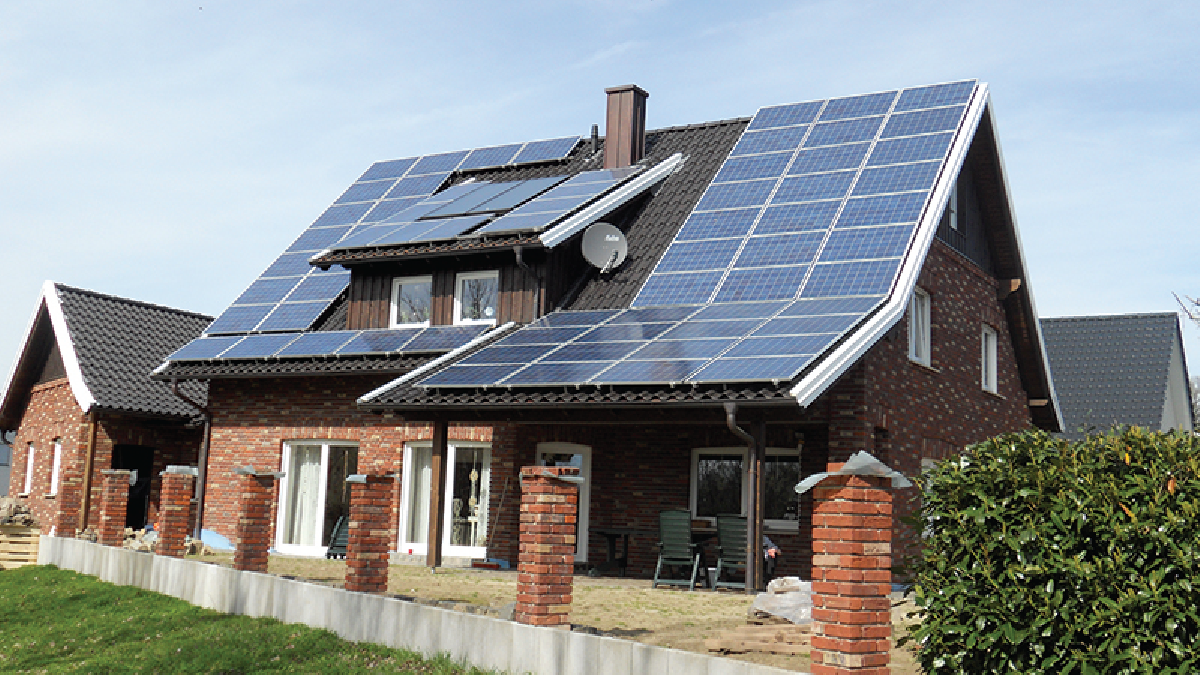
Of grade, if businesses are to succeed in selling environmentally friendly products, they must have consumers willing to buy them. A homeowner has to exist ready to spend twenty per centum more than the toll of a traditional roof to install solar roofing tiles that reduce the consumption of electricity generated by fossil fuels ((Figure)).
Although solar panels can reduce your carbon footprint, the tiles are much more expensive than standard roofing tiles. (credit: "Typical Solar Installation" by Tim Fuller/Flickr, CC By two.0)
Some other personal decision is whether to purchase a $35,000 Tesla Model three electric car. While information technology reduces the driver'southward carbon footprint, it requires charging every 250 miles, making long-distance travel a claiming until a national system of charging stations is in identify.
Tesla's founder, Elon Musk, is also the founder of SpaceX, an aerospace manufacturer that produces and launches the just space-capable rockets currently in existence in the United States. Thus, when NASA wants to launch a rocket, it must do so in partnership with SpaceX, a private company. It is ofttimes the case that private companies develop of import advances in technology, with incentives from government such as tax credits, low-interest loans, or subsidies. This is the reality of capital-intensive, high-tech projects in a costless-market place economy, in which government spending may exist limited for budgetary and political reasons. Not only is SpaceX making the rockets, merely it is making them reusable, with long-term sustainability in mind.
Critical Thinking
- Should corporations and individual consumers bear articulation responsibility for sustaining the surroundings? Why or why non?
- What obligation does each of united states of america have to be aware of our own carbon footprint?
- If private consumers have some obligation to support environmentally friendly technologies, should all consumers bear this responsibility equally? Or just those with the economic means to do then? How should lodge decide?
Summary
Adopting sustainability every bit a strategy means protecting the environs. Society has an interest in the long-term survival, indeed the flourishing, of ecological habitats and natural resources, and we enquire and expect companies to respect this societal goal in their business organization activities.
When analyzing what a business owes gild in return for the freedom to extract our natural resources, we must balance development and preservation. It may be easy to say from afar that a business should cut back on how much it pollutes the air, but what happens when that ways cut back on fossil fuel apply and transitioning to electric vehicles, a choice that affects everyone on a personal level?
Assessment Questions
What is earth jurisprudence?
Earth jurisprudence is an estimation of police and governance based on the belief that order will be sustainable only if we recognize the legal rights of Globe as if it were a person.
Which of the post-obit best describes the tragedy of the commons?
- People are always willing to sacrifice for the good of guild.
- People are likely to utilize all the natural resources they want without regard to others.
- The common practiced of the people is a pop corporate goal.
- Tragedies occur when there is also much government regulation.
B
ISOs are sustainability standards for businesses ________.
- promulgated by the state regime
- promulgated by the federal government
- promulgated past the Earth Trade Arrangement
- none of the above
D
True or simulated? If environmental harm is discovered, the business entity causing it is frequently held liable past both the government and the victims of the harm in divide proceedings.
True
Which of the following is a potentially effective way to reduce global warming?
- build more coal-burning ability plants
- build more diesel-burning cars
- implement a carbon tax
- implement taxation-free gasoline
C
Endnotes
19H.J. Graham, Everyman's Constitution. (Madison: State Historical Society of Wisconsin, 1968). Encounter likewise H.J. Graham, "The 'Conspiracy Theory' of the Fourteenth Subpoena," Yale Law Journal 47, no. 3 (1938): 341–403. doi: x.2307/791947.
20"Ecuador Adopts Rights of Nature in Constitution," The Rights of Nature. https://therightsofnature.org/ecuador-rights/.
21 M. Triassi, et al., "Environmental Pollution from Illegal Waste Disposal and Wellness Furnishings," Int J Environ Res Public Health 12, no. 2 (2015): 1216–1236. doi: x.3390/ijerph120201216.
22Gwynn Guilford, Quartz, December 9, 2014. https://qz.com/308970/cruise-ships-dump-ane-billion-tons-of-sewage-into-the-ocean-every-twelvemonth/.
23Country of the Globe 2010 Transforming Cultures from Consumerism to Sustainability. Washington, DC: The Worldwatch Institute, 2010.
24Rights of Nature, "Principles of Earth Jurisprudence." https://therightsofnature.org/principles-of-earth-jurisprudence/.
25Garrett Hardin, "The Tragedy of the Commons," Science 162, no. 3859 (1968): 1243–1248. doi: ten.1126/scientific discipline.162.3859.1243.
26Jeff Kauflin, "The World'due south Nearly Sustainable Companies 2017," Forbes, January 17, 2017. https://www.forbes.com/sites/jeffkauflin/2017/01/17/the-worlds-about-sustainable-companies-2017/#2773f73a4e9d.
27Corporate Knights, "2018 Global 100." http://www.corporateknights.com/reports/global-100/.
28Jeff Kauflin, "The World's Most Sustainable Companies 2017," Forbes, Jan 17, 2017. https://www.forbes.com/sites/jeffkauflin/2017/01/17/the-worlds-most-sustainable-companies-2017/#2773f73a4e9d.
293BLMedia, "2015 Cisco Corporate Social Responsibility Report: Supply Chain," 2015. http://3blmedia.com/News/2015-Cisco-Corporate-Social-Responsibility-Report-Supply-Chain.
30McKinsey & Co., "Sustainability's Strategic Worth," 2016. http://csr-raadgivning.dk/wp-content/uploads/2016/02/Sustainabilitys-strategic-worth-McKinsey-Global-Survey-results-McKinsey-July-2014.pdf.
31Paul Raleigh, "Corporate Social Responsibility: Beyond Financials," Grant Thornton, August 13, 2014. https://www.grantthornton.global/en/insights/articles/Corporate-social-responsibility/.
32Jessica Lyons Hardcastle, "Dell's Flexible Piece of work Programs Save $12M, Reduce GHGs," Environmental Leader, July 10, 2014. https://www.environmentalleader.com/2014/07/dells-flexible-work-programs-save-12m-reduce-ghgs/.
33Knut Haanaes, "Making Sustainability Profitable," Harvard Business Review, March 2013. https://hbr.org/2013/03/making-sustainability-profitable.
34Adam Wernick, "The U.South. Defense Department Takes Climate Change Seriously," Public Radio International, October 8, 2017. https://www.pri.org/stories/2017-10-08/u.s.-defense force-department-takes-climate-change-seriously.
35Union of Concerned Scientists, "Global Warming Impacts." https://www.ucsusa.org/our-work/global-warming/science-and-impacts/global-warming-impacts#.WjQa11WnF0w.
36Lucy P. Marcus, "Why Strong Ties between Business and Government Matter," The Guardian, January 4, 2016. https://www.theguardian.com/business organisation/2016/jan/04/why-strong-ties-between-business-and-government-affair-r-and-d.
37Union of Concerned Scientists, "Global Warming Impacts." https://www.ucsusa.org/our-piece of work/global-warming/scientific discipline-and-impacts/global-warming-impacts#.WjQa11WnF0w.
38National Conference on Country Legislatures, "State Plastic and Paper Handbag Legislation," July 5, 2017. http://www.ncsl.org/research/environment-and-natural-resources/plastic-bag-legislation.aspx.
39Elizabeth Chuck, "Hurricane Harvey: How Many Billions of Dollars in Damage Will Historic Storm Cost?" NBC News, August xxx, 2017. https://www.nbcnews.com/storyline/hurricane-harvey/how-many-billions-damage-will-harvey-cost-southward-anyone-s-n797521.
40NASA, "Written report on Climatic change," March 22, 2018. https://climate.nasa.gov/bear witness/.
41James Brooke, "Waste Dumpers Turning to West Africa," New York Times, July 17, 1998. http://www.nytimes.com/1988/07/17/world/waste-dumpers-turning-to-w-africa.html?pagewanted=all.
42Financial Transparency Coalition, "Cantankerous-border Dumping of Hazardous Waste," Baronial 20, 2010. https://financialtransparency.org/hazardous-waste/.
43Andrew Winston, "Business organization Owes the World Everything . . . and Naught," Harvard Business Review, May 4, 2010. https://hbr.org/2010/05/business-owes-the-world-everyt.html.
44Lew Harris, "Business Owes Pregnant Obligations to Society," Newswise, Feb 23, 2000. https://www.newswise.com/articles/business organisation-owes-pregnant-obligations-to-lodge.
45Climate Leadership Quango, "The Four Pillars of Our Carbon Dividends Plan." https://www.clcouncil.org/our-program/.
46John Schwartz, "Exxon Mobil Lends Its Support to a Carbon Tax Proposal," New York Times, June 20, 2017. https://www.nytimes.com/2017/06/twenty/science/exxon-carbon-tax.html.
47John Schwartz, "Exxon Mobil Lends Its Back up to a Carbon Tax Proposal," New York Times, June 20, 2017. https://www.nytimes.com/2017/06/20/science/exxon-carbon-tax.html.
48Katy Lederer, "Why Can't Republicans Support a Carbon Revenue enhancement?" The New Yorker, November 9, 2015. https://www.newyorker.com/business/currency/why-cant-republicans-support-a-carbon-tax.
Glossary
- cap and merchandise
- a organisation that limits greenhouse gas emissions by companies while allowing them to purchase and sell pollution allowances
- carbon footprint
- the amount of carbon dioxide and other carbon compounds released by the consumption of fossil fuels
- carbon tax
- a pay-to-pollute system in which those who discharge carbon into the air pay a fee or tax
- corporate personhood
- the legal doctrine holding that a corporation, divide and autonomously from the people who are its owners and managers, has some of the same legal rights and responsibilities enjoyed by natural persons
- sustainability
- a long-term arroyo to the interaction between business action and societal impact on the surround and other stakeholders
- tragedy of the eatables
- an economy theory highlighting the man tendency to utilise as much of a free natural resources equally wanted without regard for others' needs or for long-term environmental effects or issues

For The Additional Green Spaces To Be Considered Public Services, What Must Be True?,
Source: https://opentextbc.ca/businessethicsopenstax/chapter/sustainability-business-and-the-environment/
Posted by: beginsurtly.blogspot.com
0 Response to "For The Additional Green Spaces To Be Considered Public Services, What Must Be True?"
Post a Comment